
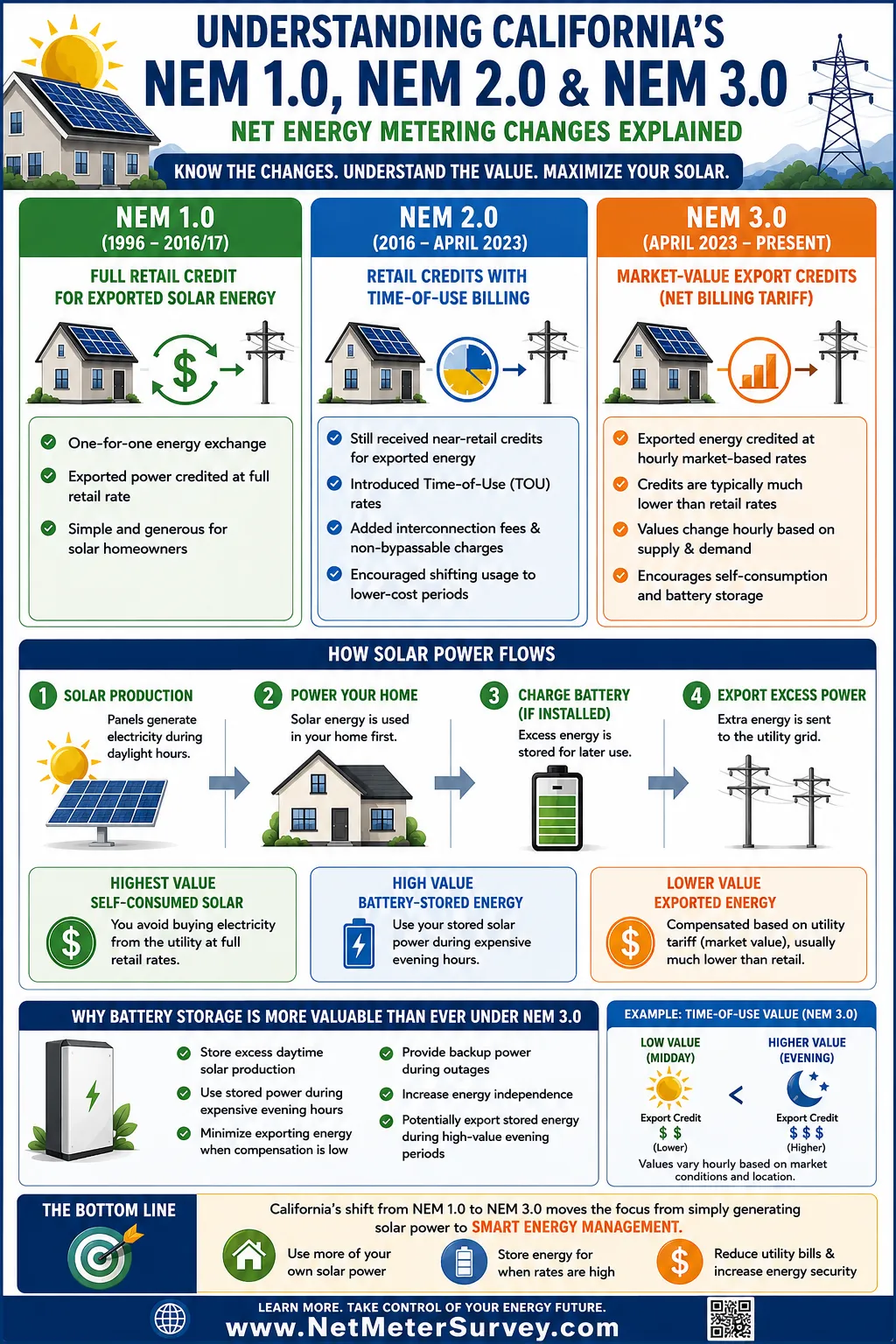
Understanding California's NEM 1.0, NEM 2.0, and NEM 3.0 (Net Billing Tariff)
What Every Homeowner Should Know About Solar Energy Exchange Rates
California's Net Energy Metering (NEM) programs have evolved significantly over the past three decades. While the goal has always been to encourage clean energy adoption, each version has changed how homeowners are compensated for the electricity their solar system sends back to the utility grid. The biggest shift has been moving away from paying homeowners the full retail value of exported electricity toward paying a market-based value that more closely reflects the actual value of energy at the time it is delivered.
(Prefer to Keep the Same NEM you Started On if you have solar)
Program - Primary Benefit
Key Changes
NEM 1.0 (1996–2016/17)Full retail credit for exported solar energy
Simple one-for-one energy exchange
NEM 2.0 (2016–April 2023)Retail credits with Time-of-Use billing
Added interconnection fees and non-bypassable charges
NEM 3.0 / Net Billing Tariff (April 2023–Present)
Market-value export creditsEncourages battery storage and self-consumption
How Solar Production Works
A solar system generates electricity during daylight hours. That electricity is used in the following order:
Power your home first – Your home consumes the electricity your solar panels produce.
Charge a battery (if installed) – Any remaining energy can be stored for later use.
Export excess power – Surplus electricity is sent to the utility grid.
The value of each kilowatt-hour (kWh) depends on how it is used.
Self-consumed solar energy provides the greatest value because it offsets electricity you would otherwise purchase from the utility at full retail rates.
Battery-stored energy allows homeowners to use their own solar power during expensive evening hours when utility rates are highest.
Exported energy is compensated according to the utility's current tariff, which has changed substantially under NEM 3.0.
Understanding Energy Exchange Rates
Under NEM 1.0, homeowners generally received nearly the same value for electricity they exported as they paid for electricity they purchased from the utility.
NEM 2.0 maintained similar export values but introduced Time-of-Use (TOU) rates, requiring customers to pay small grid-related charges and encouraging electricity use during lower-cost periods.
With NEM 3.0 (Net Billing Tariff), imported electricity and exported electricity are valued differently:
Electricity purchased from the utility is billed at retail Time-of-Use rates.
Electricity sold back to the utility is credited at hourly market-based values that are typically much lower than retail prices, although credits may increase during periods of high grid demand, such as summer evenings.
Why Batteries Have Become More Valuable
Because exported solar energy is generally worth less than electricity purchased from the utility, battery storage has become one of the most valuable components of a modern solar system.
A battery allows homeowners to:
Store excess daytime solar production.
Reduce purchases of expensive evening electricity.
Minimize exporting energy when compensation is low.
Provide backup power during outages.
Improve energy independence.
Potentially export stored energy during higher-value evening periods when utility compensation increases.
California's transition from NEM 1.0 to today's Net Billing Tariff reflects a shift from rewarding simple solar generation to rewarding smart energy management. Homeowners now receive the greatest financial benefit by using as much of their own solar production as possible and pairing solar with battery storage. While export compensation has decreased under NEM 3.0, rising retail electricity prices continue to make solar and battery systems an effective long-term investment by reducing dependence on utility power and increasing resilience during outages.